
Searching Hard Coded Values

Searching Hard Coded Values from Entire Database-Objects is very Interesting Task for me. My last Blog (Search Dynamic Values) was for Dynamic Values from Tables. Today I want to show how I am searching Hard Coded values (E-mail Ids and Mobile numbers) from all Procedures or Views from our Database.We should avoid the Hard codes in objects.
To manages Hard codes in objects  i was simply Converting all procedures and Views in script and after that using find -replace i was managing changes...It was very time consuming and bothering work form me... Below Query help and save my lot of time for learning extras.....
       

declare @text varchar(100)
declare @dbname varchar(100) 
  
  set @text = 'sumank'
  set @dbname = 'masterdatabase'

if @dbname is null
begin
--enumerate all databases.
DECLARE #db CURSOR FOR Select Name from master..sysdatabases
declare @c_dbname varchar(64)
  

OPEN #db FETCH #db INTO @c_dbname
while @@FETCH_STATUS <> -1 --and @MyCount < 500
   begin
     execute find_text_in_sp @text, @c_dbname
     FETCH #db INTO @c_dbname
   end 
  CLOSE #db DEALLOCATE #db
 end --if @dbname is null
else
 begin --@dbname is not null
  declare @sql varchar(250)
  --create the find like command
  select @sql = 'select ''' + @dbname + ''' as db, o.name,m.definition '
  select @sql = @sql + ' from '+@dbname+'.sys.sql_modules m '
  select @sql = @sql + ' inner join '+@dbname+'..sysobjects o on m.object_id=o.id'
  select @sql = @sql + ' where [definition] like ''%'+@text+'%'''
  execute (@sql)
 end --@dbname is not null


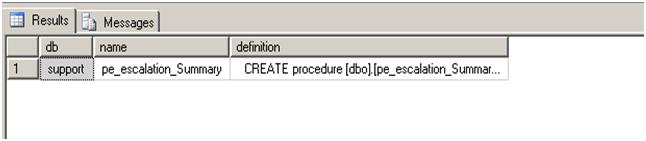
Result :-


@sumanjha

Comments

Post a Comment

Plz dont forget to like Facebook Page..
https://www.facebook.com/pages/Sql-DBAcoin/523110684456757

Popular posts from this blog

History of MySQL from AB Corp to Cloud Database

MySQL was created by a Swedish company, MySQL AB, founded by David Axmark, Allan Larsson and Michael "Monty" Widenius. Original development of MySQL by Widenius and Axmark began in 1994. The first version of MySQL appeared on 23 May 1995. Its name is a combination of "My", the name of co-founder Michael Widenius's daughter,and "SQL", the abbreviation for Structured Query Language. ·          23 May 1995 - First internal release ·          Year 1996 - Version 3 o     Simple CRUD operations o     January 1997 Windows version was released on 8 January 1998 for Windows 95 and NT o     production release 1998, from www.mysql.com ·          Year 2002 - Version 4 o     MyISAM o     unions o     Tracking o     B-trees o     s...

Configure Impersonation Authentication in IIS8 for MVC Application

Impersonation is when ASP.NET executes code in the context of an authenticated and authorized client. By default, ASP.NET does not use impersonation and instead executes all code using the same user account as the ASP.NET process, which is typically the ASPNET account. There are 5 below steps by which we can establish Impersonation configuration in our secured application environment. 1.)    Creation of Application/Proxy user where Application is hosted. 2.)    Give appropriate access to the user. 3.)    Create Database Login user on database. 4.)    Authenticate User and provide credential on IIS. 5.)    Then Configure web.config on Application.

How to add an article in Transactional Replication

If we have a set-up of Transactional Replication for Data Distribution running and wanting to add new object to replication on other server we can follow below process. To add an article In Transaction replication with PUSH Subscription