
Remote Access Enabling in MySQL using Workbench

MySQL became part of my skill set in 2014. After installation of any instance of MySQL Server in Production or Test environment 2nd most task for any DBA is to connect the Database from Remote. While i was new with MySQL it played with me a lot to do this task from remote machine. I hang over for 3 days and ask many ppl and search many site. Did telnet, ip-config, firewall et………….. but resolve my problem in easy through below process…
  1. 1st Grant Remote Permission on Database Server
  2. 2nd Configure Connection at client workbench to server


How to grant permission on Database Server?
GRANT ALL PRIVILEGES ON *.* TO 'suman'@'%' IDENTIFIED BY 'xxx@123';

Now come back to Client – pc or desktop where workbench client is installed.

Configure new connection like below…

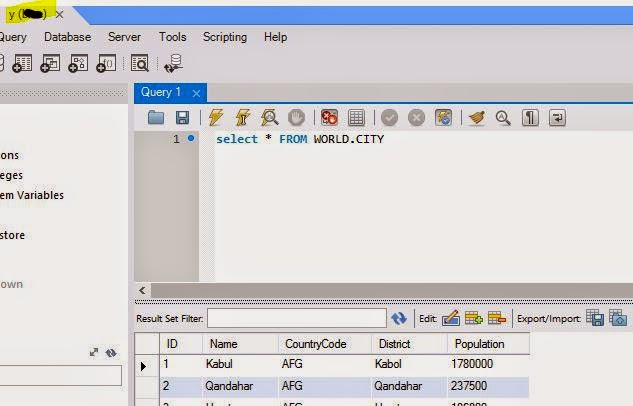
Result is cool... connected to server from client
Comments

Popular posts from this blog

History of MySQL from AB Corp to Cloud Database

MySQL was created by a Swedish company, MySQL AB, founded by David Axmark, Allan Larsson and Michael "Monty" Widenius. Original development of MySQL by Widenius and Axmark began in 1994. The first version of MySQL appeared on 23 May 1995. Its name is a combination of "My", the name of co-founder Michael Widenius's daughter,and "SQL", the abbreviation for Structured Query Language. ·          23 May 1995 - First internal release ·          Year 1996 - Version 3 o     Simple CRUD operations o     January 1997 Windows version was released on 8 January 1998 for Windows 95 and NT o     production release 1998, from www.mysql.com ·          Year 2002 - Version 4 o     MyISAM o     unions o     Tracking o     B-trees o     s...

How to add an article in Transactional Replication

If we have a set-up of Transactional Replication for Data Distribution running and wanting to add new object to replication on other server we can follow below process. To add an article In Transaction replication with PUSH Subscription 

Configure Impersonation Authentication in IIS8 for MVC Application

Impersonation is when ASP.NET executes code in the context of an authenticated and authorized client. By default, ASP.NET does not use impersonation and instead executes all code using the same user account as the ASP.NET process, which is typically the ASPNET account. There are 5 below steps by which we can establish Impersonation configuration in our secured application environment. 1.)    Creation of Application/Proxy user where Application is hosted. 2.)    Give appropriate access to the user. 3.)    Create Database Login user on database. 4.)    Authenticate User and provide credential on IIS. 5.)    Then Configure web.config on Application.